2. The Soneium Solution
2.1 Tokenized IP
2.1.1 Bridging IP and Capital Markets
Intellectual property represents one of the largest asset classes in the world, yet it remains structurally excluded from direct ownership. Soneium addresses this gap by providing the infrastructure for Tokenized IP: the representation of creative works as programmable, tradeable onchain assets, without transferring ownership or decision-making authority away from the creator.
- Copyright and creative control remain with the rights holder at every stage.
- What is made available to the market is a claim on future value generated by the work, not the underlying rights themselves.
- Creators determine independently whether, when, and how participation is offered.
2.1.2 Forms of Tokenized IP
Tokenized IP transforms intellectual property into an onchain asset by bringing a work's future value onchain, from licensing to production, as programmable assets. For creators, Tokenized IP is a new way to raise funds for their next work and to grow it together with the fans and investors who support it. Soneium offers Tokenized IP in three forms, each opening a different way for fans and investors to take part in the IPs they care about:
- IP Token
- The tradable units of an individual studio or title, issued either as collectibles or as fungible tokens.
- Collectibles act as proof of fandom and can be used across fan activities, while fungible tokens are designed to circulate as the main currency inside an IP's economy.
- Both let fans and investors pool capital to fund an IP's expansion and share in its success through onchain royalty distribution.
- IP Vault
- Access to entertainment investment opportunities such as music catalog funds.
- Participants deposit into a vault and receive a position whose value follows the performance of the underlying IP-backed assets, such as royalty income from music and entertainment catalogues.
- IP Bond
- A bond product backed by entertainment businesses.
- The initiative offers fans and investors a new way to take part in the revenue generated by live entertainment.
Across all forms, Soneium powers the entire economic lifecycle. Capital reaches creators and IP owners, studios scale into lasting businesses, and value flows back to the fans and investors who backed them.
2.1.3 Lifecycle-Based Market Structure
Soneium's Tokenized IP framework is structured around the lifecycle stage of a given IP rather than a single fundraising event, allowing market access to expand in proportion to an IP's demonstrated traction.
- Early stage: New works are backed by a small group of early fans and investors, aligning first capital with committed fandom.
- Growth stage: As an IP builds a track record, participation can expand to a wider community with shared exposure to its performance.
- Mature stage: Established IP can support open, liquid trading, converting future value into present capital that can be reinvested directly into new creative output.
2.1.4 Fan Alignment and Architectural Integration
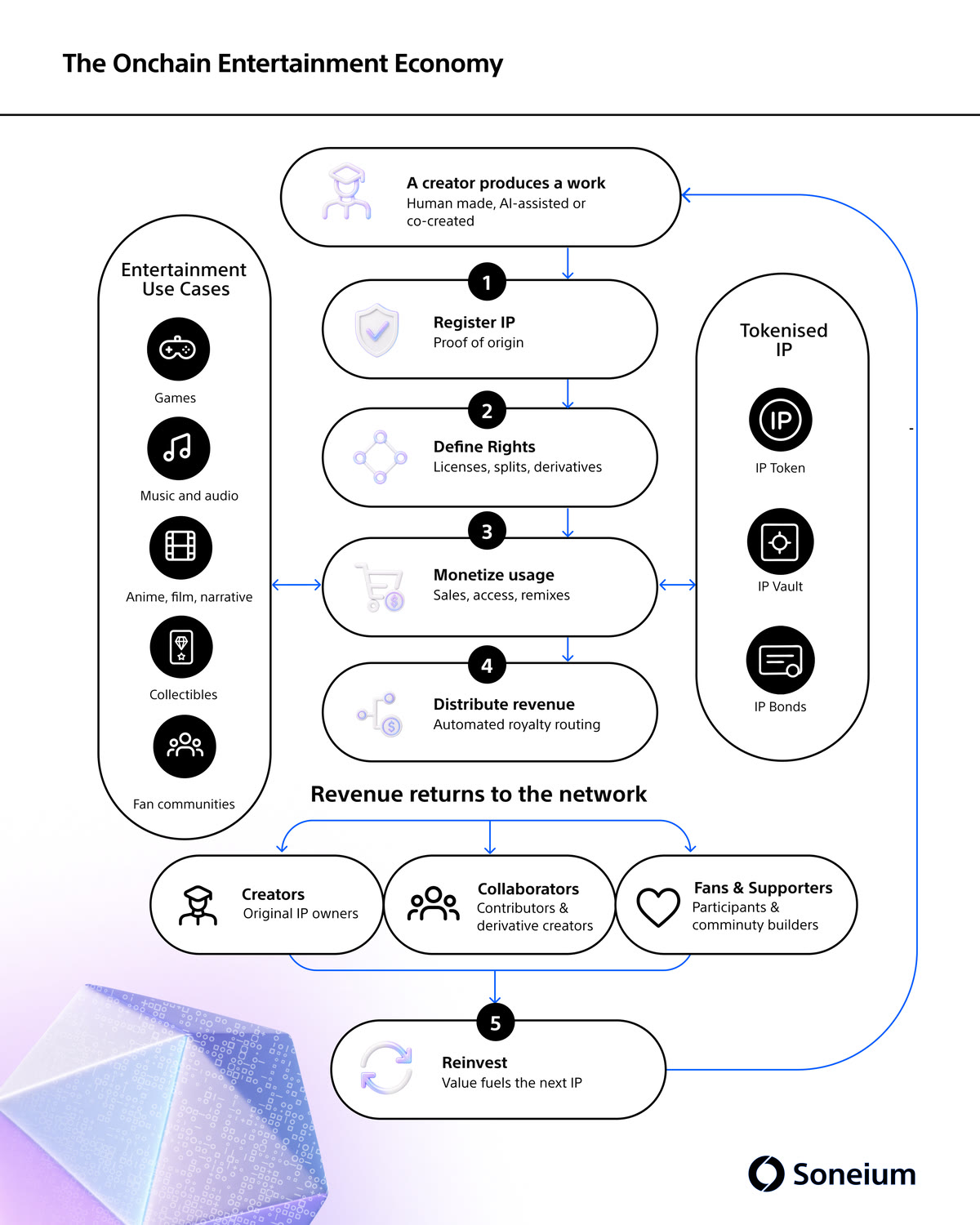
Tokenized IP extends the incentive structure of fandom into an economic dimension, while remaining fully integrated with Soneium's Onchain IP Architecture rather than functioning as a standalone financial product.
- Fans and communities holding a stake in an IP's performance are directly aligned with its growth, reinforcing the organic distribution and advocacy fan communities already provide.
- Tokenized instruments reference and settle against the registration, attribution, and royalty data generated by the IP Registry, Graph, and Execution layers (Section 2.2).
- This integration provides the technical infrastructure for a tokenized IP market, while Soneium's entertainment ecosystem and application layer deliver the demand-side reach to meet it.
2.1.5 Soneium Portal
To power this ecosystem, Soneium is introducing the Soneium Portal, the official Tokenized IP platform, serving as the primary hub for IP discovery and investment. As the main user entry point to the ecosystem, it starts with primary sales and expands into fan participation and royalty distribution, creating a dedicated home where communities can discover IP and take part in its growth.
2.2 Onchain IP Architecture
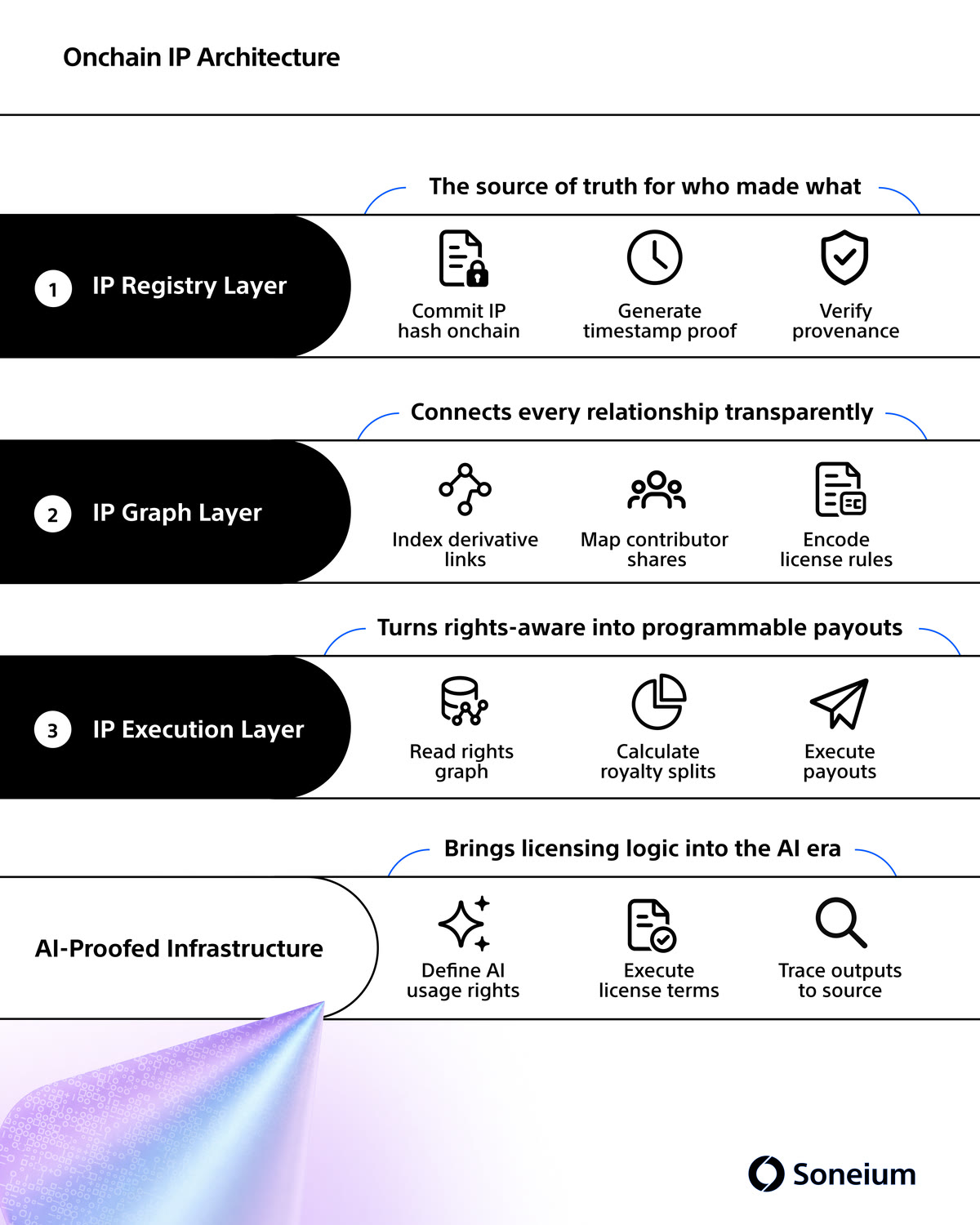
Onchain IP architecture is Soneium's foundational layer, designed to support the full creative lifecycle: register → relate → monetize → prove authenticity. Furthermore, Soneium's architecture is rooted in open standards. By developing and proposing open standards for onchain entertainment, Soneium ensures that the ecosystem remains open, stable, and easily adoptable by the broader creative community.
1. IP Registry Layer (Registration and Verification)
- Registers creative works by anchoring metadata and content hashes onchain.
- Provides timestamped proof of creation, protecting pre-release content and establishing origin.
- Enables differentiation between official works and derivatives, supporting all forms of creative expression.
- Acts as the root of trust for authenticity.
2. IP Graph Layer (Attribution and Relationship Management)
- Manages complex creative relationships: original → derivative, collaboration structures, source material → AI-generated content.
- Enables transparent contribution visibility and automatic license reference.
- Supports fair recognition of all contributors and creation methods.
3. IP Execution Layer (Value Distribution and Automation)
- Automatically executes royalty distribution and revenue allocation through smart contracts.
- References IP Graph data to ensure all rights holders and contributors receive appropriate value.
- Turns creative works into assets that keep creating value.
4. AI-Proof Infrastructure
AI agents can find a song, a clip, or an illustration and reuse it in seconds. Working out what they are allowed to do with it is harder, because that information lives in contracts and platform databases rather than anywhere an agent can query. Holding Tokenized IP proves ownership; it does not express permission. To close this gap, Soneium intends to support the Onchain IP Asset and License Registry (ERC-8432), an open standard that makes licensing as queryable as the Tokenized IP itself, so that the Registry, Graph, and Execution layers can be read, checked, and settled by people and AI agents alike. ERC-8432 gives independent registries a common interface to identify Tokenized IP assets, publish machine-readable license terms, and record and verify license agreements onchain. It standardizes the mechanism rather than the legal rights themselves, and composes with adjacent primitives for agent identity and payments without imposing hard dependencies. By adopting widely recognized standards across tokens, licensing, and value distribution, Soneium enables seamless integration with existing onchain infrastructure, allowing creators and builders to leverage proven foundations while focusing on what matters most: crafting differentiated, meaningful experiences in onchain entertainment.
At the same time, Soneium takes an active role in advancing the standardization of emerging onchain primitives beyond licensing alone. As onchain entertainment evolves, new requirements continue to surface across areas such as intellectual property, provenance, attribution, and payment flows. Soneium works in close collaboration with a broad set of ecosystem participants, including industry partners and creative communities, to identify shared patterns and translate them into open, extensible standards. Supporting ERC-8432 is the first step in that direction, with extensions for payments and royalty distribution as the natural places for the ecosystem to grow next.
- Provides a common interface for independent registries to identify Tokenized IP assets, publish machine-readable license terms, and record and verify license agreements onchain, standardizing the mechanism rather than legal rights or policy.
- Addresses every record by chain, registry, and ID, so any application or AI agent can locate it unambiguously across registries and chains without a central authority or bespoke integration.
- Enables programmatic verification: applications check agreement status directly onchain, and built-in validation hooks allow an agent to confirm what it may do with a work before using it, acquiring an agreement in a single transaction where permitted.
- Composed with emerging primitives such as ERC-8004 for agent identity and payment rails like x402, without imposing hard dependencies.
- Ensures that as AI increases the volume and speed of creation, rights travel with the work: official IP keeps its integrity, creators are compensated for machine-driven use, and no participant is locked into a single platform.
Next: 3. Technical Architecture
This document describes Soneium's vision and plans, which may change. No $SONEIUM token has been issued, and nothing in this document constitutes an offer, solicitation or recommendation to acquire any token, security or other financial product in any jurisdiction. Any future token issuance by the Soneium Foundation will be subject to applicable laws and regulatory requirements.